When it comes to defending corner kicks you want to make sure your team is all on the same page. Some teams man mark, while other play zone. Both are good, but if you do zone everyone better be ready to move and protect your area. A mix of zonal and man marking is what I prefer.
The best players in the air need to be marked tight and have someone to keep them from gaining momentum while running in.
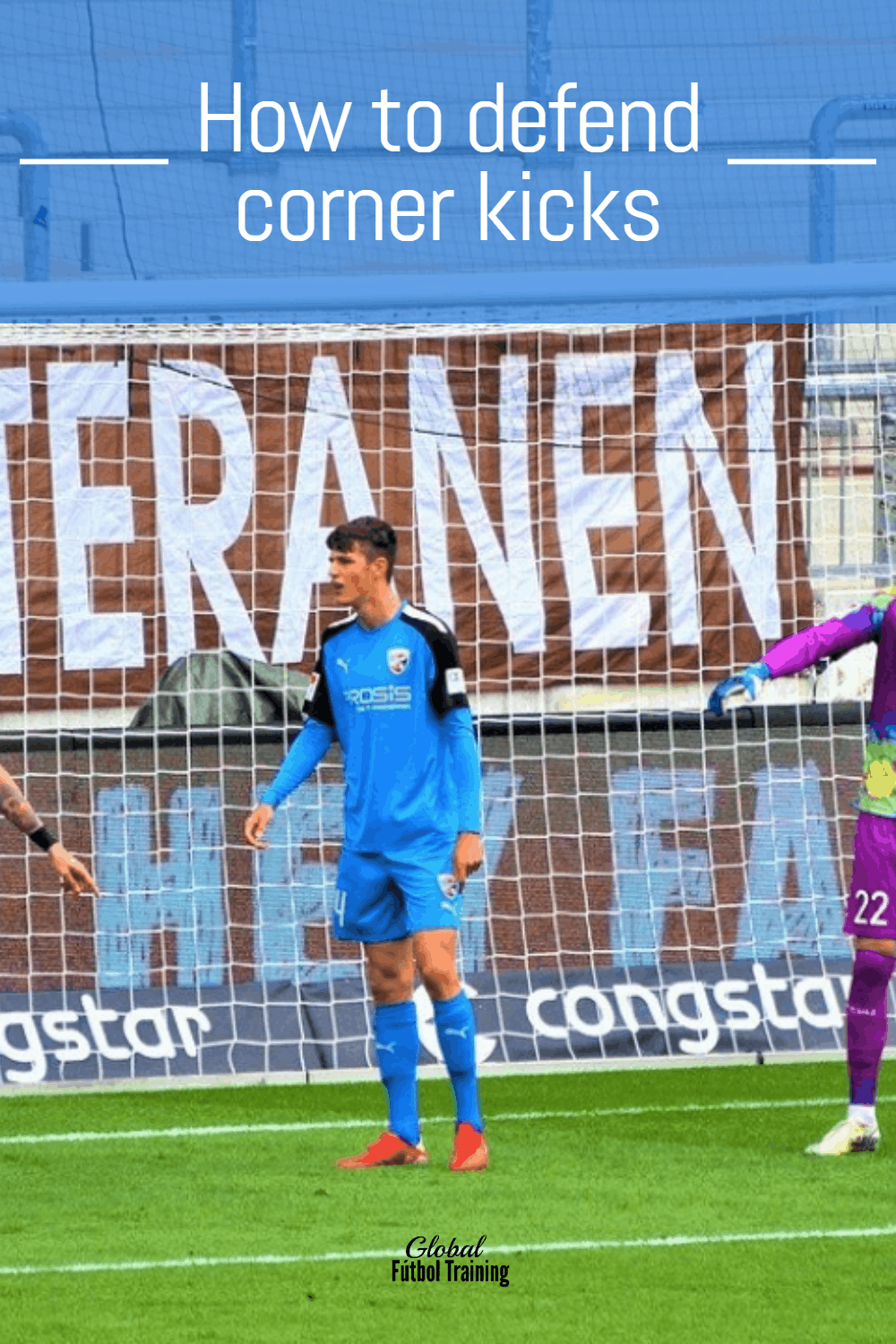
“The main communicators need to be the Keeper & Center Backs.”
Man marking while defending corner kicks
The most traditional method is to man mark.
Some teams still use it, but more are moving to the zonal & hybrid.. Like everything there are strengths and weaknesses.
Pros: When everyone does their job it’s hard for the opponents to get a clear chance on goal.
Cons: Attacking players have figured out ways to lose their marks. Example: They will start off in a cluster and right before the ball is kicked, spread out and some lay picks which prevent the defender from staying with their man.
Remember that when you are marking to be in arms length… This way if the ball does come, you’re close and therefore have the best chance to head or clear the ball away.
Zonal marking on corners
Zonal is smart, but it is also risky.
I always felt vulnerable in this system especially if you played against a team with a few players who are strong in the air.
Pros: This method makes it easier from getting picked/blocked while trying to stay with your mark running in.
Cons: If the cross is precise [into space between defenders] it can be impossible to keep the other team from scoring.
Mix or hybrid of the two
A lot of what you [coach] decide to go with depends on how strong your team is in the air.
Personally I like a mix of zonal and man mark because it gives you the best of both.
One idea is to have your best defender man mark the opponents best attacking player.
Then your other best players in the air [usually defenders] can protect the 6 yard area in a zone.
Midfielders can either man mark or play zonal about 9 yards from the goal, but they have to be ready to come closer inside as multitple runners crash in.
Pros: You can use the strengths of both systems.
Cons: There is still space between the zonal players for attackers to exploit for a 1 touch finish.

© redwall / Depositphotos.com
Ability to adapt and be organized
Whatever way you choose to defend corners there has to be good organization and ability to adapt.
Lots of goals are scored from corner kicks, so it’s best to be prepared.
Organization 101 ↓
During my college years, every game coach would have us set up where we were supposed to be… We would do this while in the locker room before going out to warm up.
We would have everyone set up how our formation already was… No reason to have a left mid have to go across the field to mark someone up.
My setup in college:
- Center backs would be in the middle of the 6.
- Outside backs would be near the corner of the 6.
- Outside mids would be on the posts.
- CM’s would be between the 6 and the pk spot.
- Forwards would be ready to cover a short corner. The other forward would be outside the 18 ready to retrieve a ball that was cleared and start a counter attack.
Covering the keeper
For the times when the goal keeper comes out, you’ll need whoever is closest to cover the goal.
In this case it’s probably going to be the middle of the goal. Especially if you have players already at the near and far posts.
It’s always best to think ahead and be prepared…
A good idea is to practice these situations and make sure it becomes a habit, especially for the center backs since they are usually the closest ones.

How to position your body
When defending a cross or corner it’s important to know where and how to position yourself.
Where is goal side of your man and if zonal wherever the coach wants each position or player.
How is positioning your body so you can see the man, ball & field.
While the ball is out wide, most players defending the corner are going to face the ball…
Instead you want to turn so that your facing the field, so that you can see the ball and opponents running in.
When defending corner kicks, never turn your back from the ball… You never know if the other teams does a quick restart.
Barcelona bad defending ⇓ not aware
Legendary goal and comeback ⇑
Preparing to counter
Defending corner kicks are scary, but it’s also a great opportunity to use the counter attack and score goals.
On the contrary, the attacking team needs to be well positioned so you don’t get scored on off a break.
When the ball pops out of the 18 and you get possession the movements on and off the ball have to be FAST.
Usually the opposing center backs are pushed up, making it a fantastic time to push forward and get chances on goal.
Step up together
Once your team has cleared or passed the ball out everyone has to “step“.
This means EVERY single player and it needs to be immediately.
The CB (center back) needs to be the one who is deepest and communicating most.
I remember in college that was one of the biggest changes… In high school is was more casual and we’d jog out, while NCAA was quick and intense.
Stepping has to be immediate and the center backs and keeper need to be the loudest.
2 reasons WHY this is important:
- So your opponents don’t win the ball back and have the ability to play deep into your box without being offsides.
- You don’t want there to be a big gap between your back line and midfield. By keeping your team shape it makes it harder for your opponents to dribble, shoot or pass.

Our Most Popular Posts:
- 3 ways to strike the ball with power
- How to play aggressive
- 8 best 1st- touch drills
- Expert dribbling tips
- Goal side defending
Follow @GFTskills on Social Media