The other day I met a college basketball coach who told me his son just started playing soccer and loves playing keeper.
I told him something simple:
Have your son kick and throw the ball against a wall so he can get used to catching the ball.
If a player will do this on their own, they will improve in a very short time — not only in catching, but also in distribution.
What surprised me was that the coach hadn’t even thought of it.
He’s a high-level basketball coach. I assumed he would know basic development principles — even if soccer is a different sport.
That conversation is why I’m making this article.
Because most families don’t realize how powerful basic goalkeeper drills can be when done consistently and correctly.
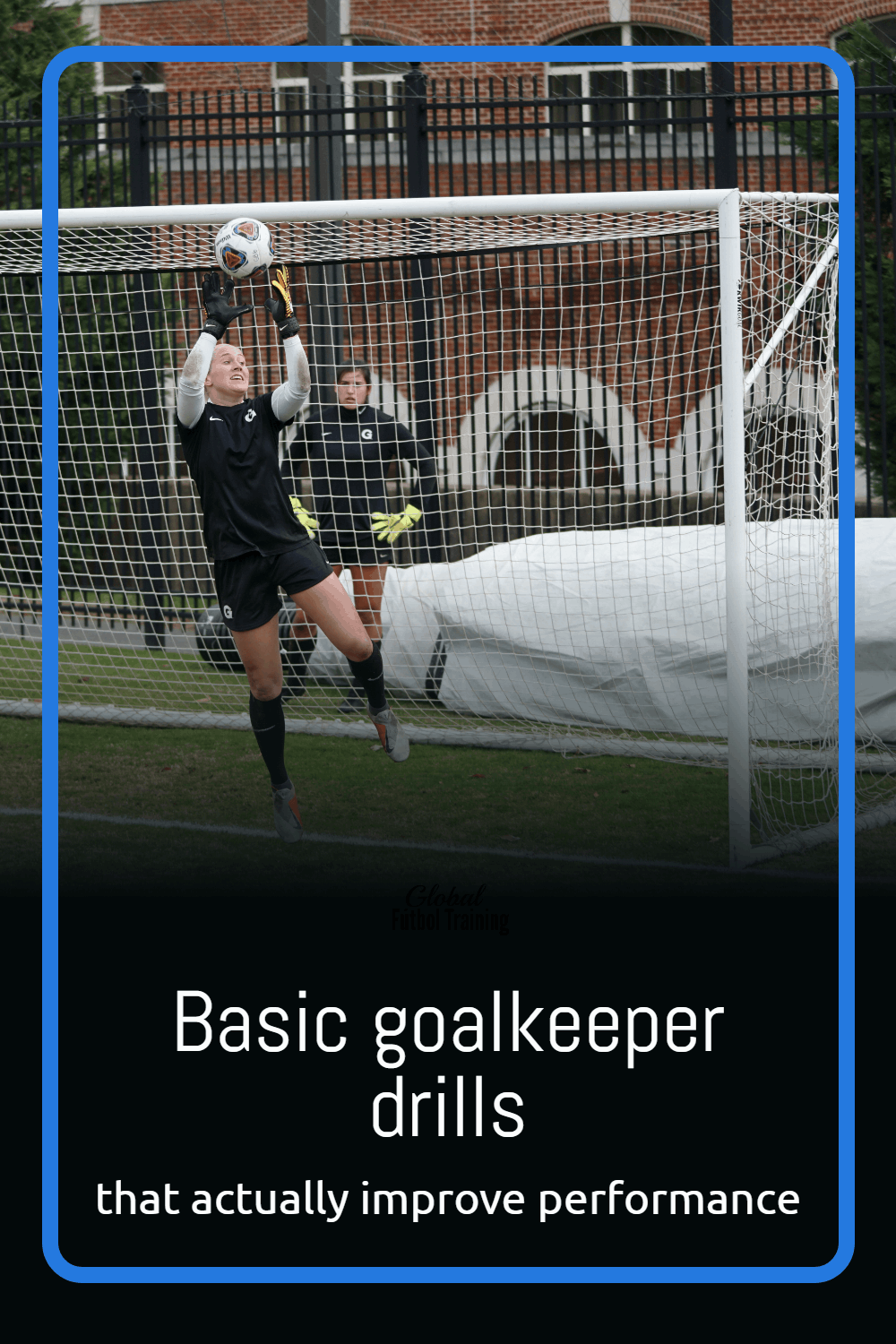
Why “Easy” Saves Are the Primary Focus
Of course there are technical and mechanical things to learn.
But if players can get really good at saving the easy shots near the body, it helps so much.
In my experience — playing professionally across 4 continents and 21+ countries, after being drafted out of a Division II school in one of the toughest draft classes in U.S. history — the biggest separator isn’t highlight saves.
It’s consistency.
Games are often lost on:
- Balls through the hands
- Shots that bounce under the body
- Low saves that aren’t secured
If you make the routine saves, a 5–0 loss can become 2–0.
And those 1-goal losses? Those disappear.
Master the easy saves first.
5 Quick Goalkeeper Drills Using a Wall
These are foundational goalkeeper drills you can do without a trainer.
Do 10 reps for each of the five drills:
1. Overhead Catching
Get close (1 yard) from the wall and throw and catch above your head.
This gets you used to saving shots that come high.
Focus: W-shaped hand position. Clean catch. No bobble.
2. Chest & Belly Catching
Underhand throw from about 3 yards away. Bring the ball into your chest by wrapping it with your hands and arms.
Make it a habit.
When the ball comes at your stomach or waist, secure it against the body.
3. Overhand Throwing
Throw overhand so you get better at distribution and saving rebounds.
This builds arm strength and coordination.
4. Low Saves With Backup Legs
Save balls down low using your hands, but get your legs behind the ball in case it goes through.
This is critical.
5. Low Save + Kick Start
Same as #4, but kick instead of throw when starting each rep.
This adds footwork and reaction.
Find a wall (brick, concrete, wood). It doesn’t have to be big.
Goalkeeper Catching & Volley Drill
There are two key elements here:
- The volley (kick) is similar to a punt. It helps build clean connection and confidence.
- Catching the rebound is even more important because that’s how you save shots in games.
Watch how the player in pink adjusts differently each time.
Sometimes she scoots over and keeps her body behind the ball.
Other times it comes straight back.
When the ball comes lower (stomach/waist), bring it into your body.
When it comes higher (chest/face), catch it with your hands like a wide receiver.
Video:
Basic to Advanced Drills Goalkeepers Need
You don’t need a trainer for most goalkeeper drills.
A wall or rebounder can do the job.
- Stand 4–5 yards away for basic catching.
- Move 10+ yards back for reaction saves or diving adjustments.
Video:
Communication: The Overlooked Goalkeeper Skill
The goalkeeper and center back should talk the most.
Why?
Because they see everything.
5 things to say:
- Step up / Step out
- Drop
- Watch left/right/behind
- Man on
- You have time
Be a leader.
Sometimes firm. Always encouraging.
Elite goalkeepers control the game with their voice before they ever touch the ball.
Goal Kicks: The Technical Edge
One of the biggest weaknesses in youth soccer is poor goal kicks.
Often a defender takes them instead.
The key is proper form.
Video:
You can kick hard, but if your mechanics are wrong, you won’t get lift or accuracy.
Patience and repetition are required.
It can take months to click.
The advantage?
Most of your competition won’t put in the time.
Most Important Thing for Keepers
Making the easy saves is the most important thing.
Shots barely above the head, at the body and low.
Even professionals miss the unstoppable ones.
No one blames you for those.
They blame you for the routine ones.
Video example:
How This Connects to Total Skill Development
Goalkeeping isn’t separate from ball control.
Foot mechanics matter.
Coordination matters.
Mental composure matters.
That’s why the same structured repetition principles apply in my online programs:
- The Basics ($24.99) – Fundamental footskills & mechanics
- The Advanced ($149.50) – Transformational footskills & aerial control
- The Magic ($149.50) – Ball coordination most coaches don’t teach
- The Works ($249.50) – Complete soccer mastery bundle
All include real feedback from me.
If you want structured, progressive training used by select, college, and pro-level players: https://www.gftskills.com/ball-control-courses/
FAQ: Goalkeeper Drills
What are the best basic goalkeeper drills?
Wall catching, low saves, distribution practice, and communication drills are foundational. These improve hand positioning, reaction timing, balance, and leadership.
Can goalkeepers train alone?
Yes. A wall or rebounder allows repetition of handling, footwork, and distribution. Solo goalkeeper drills are effective when reps are tracked and technique is focused.
How many reps should a goalkeeper do?
A solid session includes 50–100 handling reps and 20–40 distribution reps. Quality and consistency matter more than volume.
Why are easy saves more important than spectacular ones?
Games are usually decided by routine mistakes. Securing easy saves prevents preventable goals and stabilizes the team defensively.
Related Training Articles
- https://www.gftskills.com/3-ways-strike-ball-power/
- https://www.gftskills.com/8-stationary-1st-touch-soccer-drills/
- https://www.gftskills.com/expert-tips-to-improve-your-soccer-dribbling-skills/
- https://www.gftskills.com/goal-side-defending-soccer-tips/